
 321-341-2327
SEO Best Practices 2026: What to Do, What to Avoid, and How Search Works Now
The SEO best practices that work in 2026 look nothing like the game of even two years ago. Rankings still matter, but visibility now stretches across AI Overviews, large language models, and a dozen surfaces where your buyers ask questions.
This guide breaks down the SEO best practices that actually move rankings and revenue this year, organized as clear dos and don’ts. It draws on how modern search engines evaluate content, what real ranking patterns show, and the mistakes that quietly cap most sites’ growth.
By the end, you’ll know exactly where to focus first, which outdated tactics to retire, and how to structure content so it gets cited by both Google and AI answer engines. Let’s start with how search actually works now, because everything else depends on it.
Key Takeaways
- Search intent beats keyword matching. Modern engines rank the page that best satisfies the underlying goal, not the one that repeats the phrase most.
- Topical authority wins. Interlinked content clusters around a theme outperform scattered one-off posts.
- AI Overviews reward clear, structured answers. Lead every section with a direct answer so passages can be extracted and cited.
- Technical health is non-negotiable. Core Web Vitals thresholds (LCP 2.5s, INP 200ms, CLS 0.1) gate both rankings and user trust.
- Authority comes from links and brand mentions. A few relevant, credible references outweigh volume every time.
- The fastest wins are fundamentals. Titles, internal links, and page speed compound faster than any advanced tactic.
Why SEO Best Practices Changed: How Search Works Now
Modern SEO best practices exist because search itself became a multi-surface system, not a single ranked list. Google still drives the most traffic, but discovery now happens inside AI Overviews, chat assistants like ChatGPT and Gemini, and vertical engines your audience trusts.
This matters because the same content can win or lose in several places at once. A page that ranks tenth in classic results might still be the passage an AI Overview quotes, earning visibility a #10 position never used to.
Zero-click behavior is the other reality reshaping strategy. Many searches now end on the results page itself, with the answer delivered in an AI Overview or featured snippet before the user clicks anything.
That doesn’t make SEO pointless; it changes what winning looks like. Being the cited source in that answer builds authority and brand recognition even when the click doesn’t happen, and it captures the high-intent users who click through for depth.
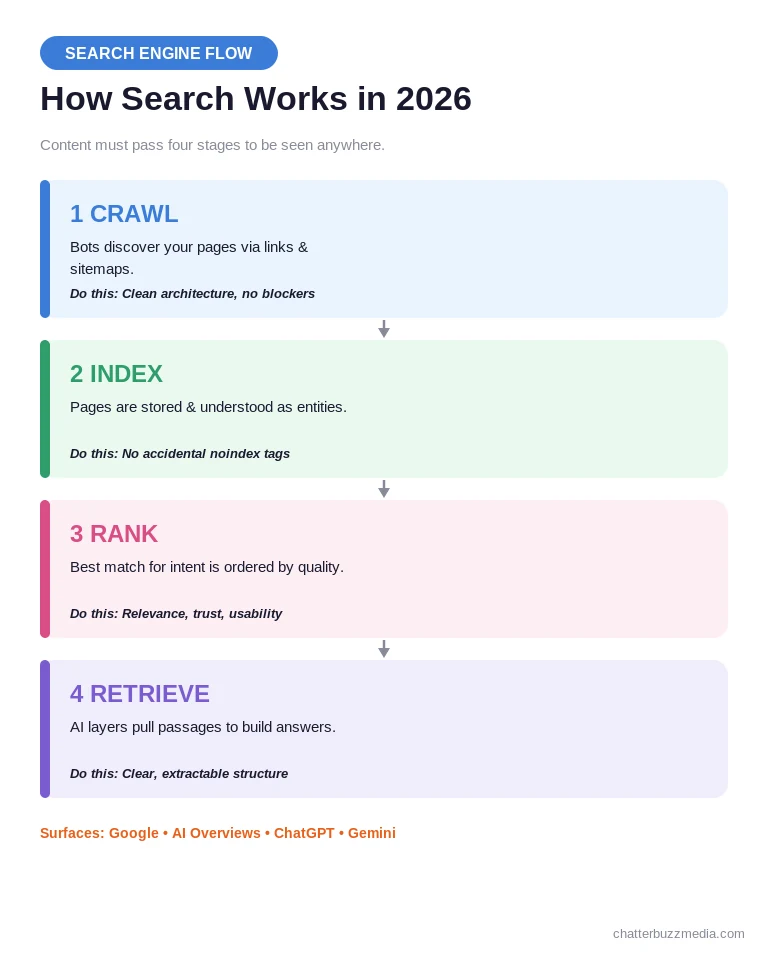
Under the hood, engines run three jobs: crawling, indexing, and ranking. AI answer layers add a fourth step, retrieval, where systems pull specific passages to assemble an answer.
If your content can’t be crawled, understood, and cleanly extracted, it’s invisible to all four. That single requirement quietly decides whether any of your other work even gets seen.
The practical shift is that you now optimize for comprehension, not just keywords. Engines evaluate whether your page genuinely resolves a query, then decide where and how to surface it.
Three forces define modern search behavior:
- Intent-first ranking: engines infer the goal behind a query and reward the page that best completes it.
- Entity understanding: Google maps people, brands, and topics as connected entities, so consistency across the web builds recognition.
- Answer extraction: AI layers lift standalone passages, so structure and clarity directly affect citations.
Google’s own explanation of how it ranks results makes the priorities explicit: relevance, quality, usability, and context all feed the final order. None of those factors reward tricks; they reward pages that clearly serve a real person.
Entity understanding deserves special attention because it quietly powers modern visibility. When Google confidently connects your brand to a topic, you start surfacing for related queries you never explicitly targeted, and AI systems inherit that same confidence.
The takeaway is simple but demanding. You’re no longer writing for one algorithm; you’re writing to be understood, trusted, and quotable across many surfaces.
That foundation makes the first best practice obvious: start with intent. Everything else in this guide builds on getting that one thing right.
Best Practice #1: Optimize for Search Intent, Not Keywords
The single most important SEO best practice in 2026 is matching search intent before anything else. Intent is the real goal behind a query, and engines now rank the page that satisfies it most completely.
Chasing exact-match keywords instead of intent is why many technically optimized pages still fail. If someone searching “best CRM” wants a comparison and you publish a product pitch, no amount of keyword density will save the ranking.
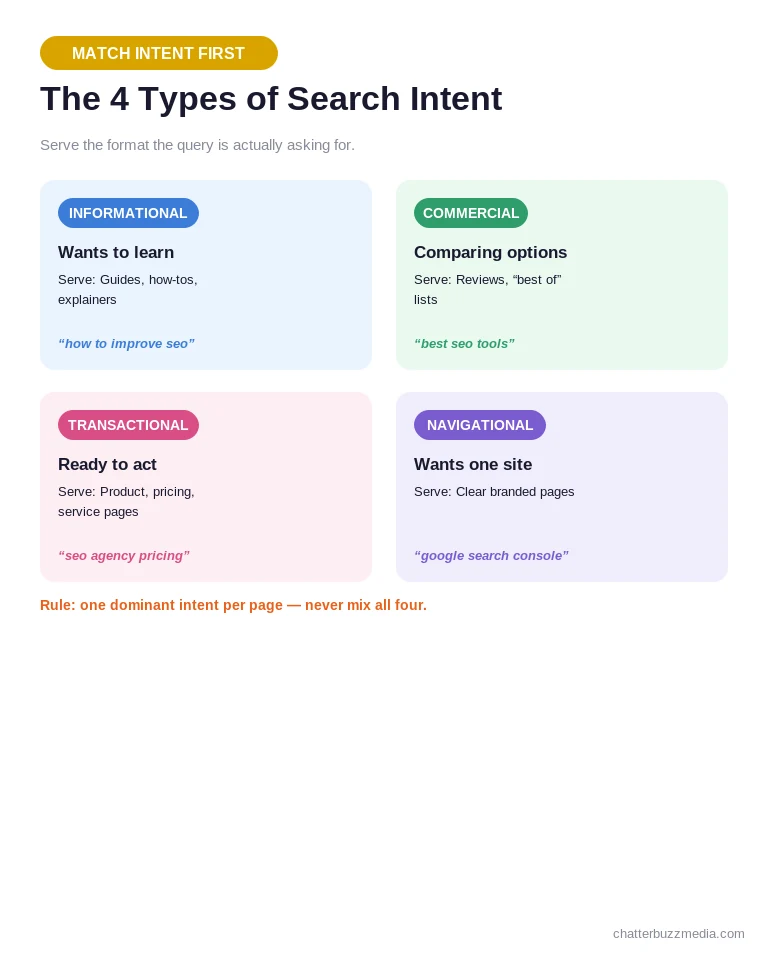
Every query maps to one of four intent types, and the right format follows from it:
- Informational: the user wants to learn. Serve guides, explainers, and how-tos.
- Commercial: the user is comparing options. Serve comparisons, reviews, and “best of” lists.
- Transactional: the user is ready to act. Serve product, pricing, or service pages.
- Navigational: the user wants a specific site. Serve clear branded pages.
To read intent accurately, study the current results for your target query. The page types Google already ranks reveal the format it considers a match, which is the clearest signal you’ll ever get.
Some queries carry mixed intent, and those are opportunities in disguise. When results blend guides and product pages, a page that satisfies both the learner and the buyer can capture a wider slice of the traffic.
Then map keywords to intent rather than volume alone. A lower-volume term with clear buying intent often drives more pipeline than a high-volume phrase full of casual browsers, a principle at the heart of any real SEO content strategy that drives revenue.
Long-tail queries deserve more attention than their volume suggests. They convert better because they signal a specific need, and they face far less competition than broad head terms, making them the fastest path to early rankings.
Modifiers in the query tell you what “done” looks like for the searcher. Words like “how,” “best,” “vs,” “near me,” and “template” each demand a different response, and matching that expectation is half the battle.
Pro tip: before writing, open the top five results and note their format, angle, and depth. If they’re all listicles and you’re planning an essay, the format is telling you to reconsider.
Intent also shifts by stage of the buyer journey, which is why one keyword rarely serves the whole funnel. A top-of-funnel guide and a bottom-of-funnel comparison need separate pages, each mapped to where the reader actually is.
DO: build each page around one dominant intent and the questions that cluster with it. DO NOT stuff a single page with mismatched keywords hoping to rank for everything at once.
Nail intent and you’ve earned the right to scale. The next practice is how you turn a single strong page into topic-wide authority.
Best Practice #2: Build Topical Authority With Clusters
Topical authority is how you win competitive categories in 2026. Instead of publishing scattered posts, you build interconnected clusters that prove deep expertise on a subject.
This works because engines and AI systems reward sources that comprehensively cover a topic, not sites that touch it once. Depth signals trust, and trust is what gets you ranked and cited.
Topical authority is also how smaller sites beat bigger ones. A focused brand that owns one subject deeply can outrank a sprawling competitor that covers it shallowly, because relevance concentrates rather than scatters.
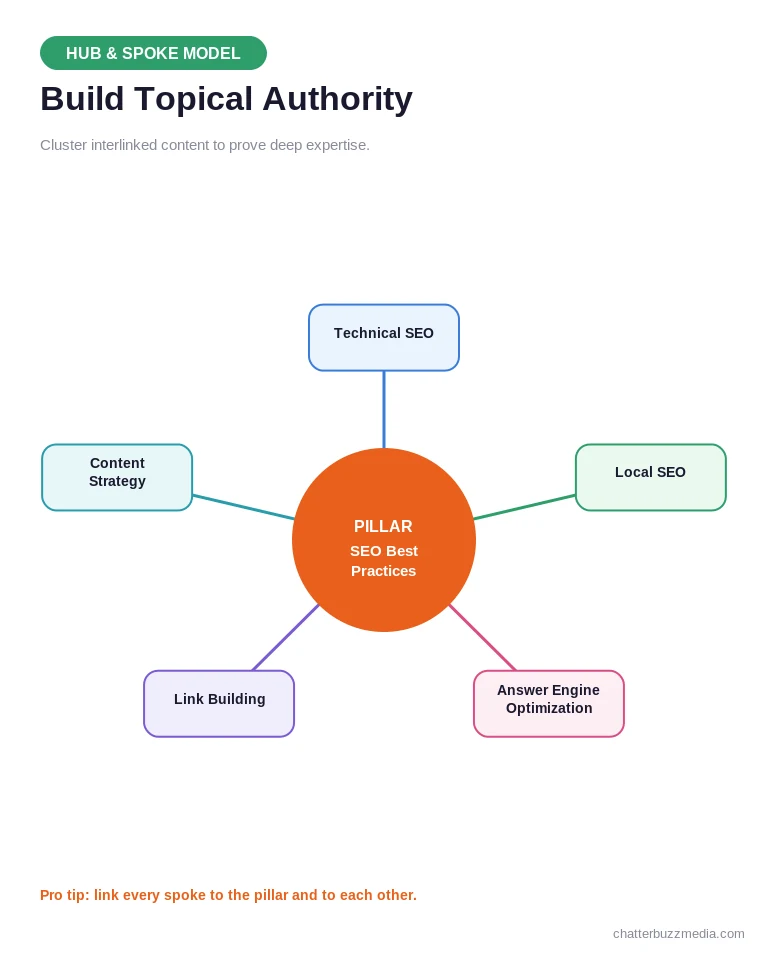
The proven structure is the hub-and-spoke model. A pillar page covers the broad topic, and supporting posts each go deep on one subtopic, all linked back to the hub.
For example, a pillar on “SEO best practices” connects to spokes on technical SEO, local search, and answer engine optimization. Together they tell Google you own the subject.
To build a cluster that compounds:
- Map the topic fully: list every question and subtopic a serious reader would need answered.
- Assign one intent per page: avoid two posts competing for the same query, which causes cannibalization.
- Interlink deliberately: connect spokes to the pillar and to each other with descriptive anchor text.
- Update the hub as you expand: keep the pillar current so it stays the strongest page.
Cannibalization is the hidden tax on sites without a cluster plan. When two pages chase the same query, they split authority and confuse engines about which to rank, so both underperform.
Fixing it is usually a matter of consolidation. Merge overlapping posts into one stronger page, redirect the weaker URL, and you often recover rankings within weeks, a common win inside a broader content strategy.
Internal links do the heavy lifting here. They pass authority between related pages and help engines understand how your content fits together, which is why SEO results compound over time rather than arriving overnight.
DO: plan clusters before you write so every post has a role. DO NOT publish thin, disconnected articles that share no links or theme.
Authority tells engines you’re credible. The next practice makes sure AI answer engines can actually extract and quote you.
Best Practice #3: Win AI Overviews and Answer Engines
To appear in AI Overviews and answer engines, lead every section with a direct, self-contained answer. These systems assemble responses by extracting passages, so clarity at the top of each section decides whether you get cited.
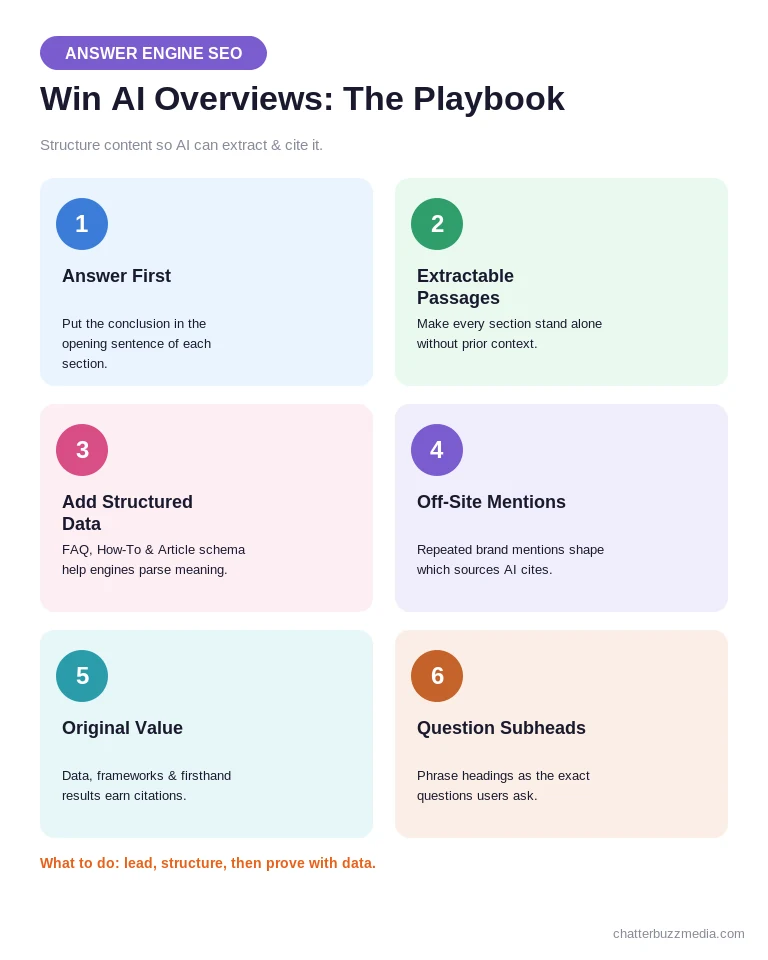
This is the biggest shift in modern search. You no longer need the #1 spot to be seen; you need the clearest passage that resolves part of the query, an approach known as answer engine optimization.
The reason it works is mechanical. Large language models retrieve and stitch together standalone chunks of text, so a well-structured passage is easy to lift while a rambling paragraph gets skipped.
Comparison tables and step lists are especially citation-friendly. They package information in a format AI systems can lift whole, which is why “best,” “vs,” and “how to” content earns outsized visibility in answer engines.
Structure is now a ranking asset. Logical headings, short paragraphs, and clean lists make your content machine-readable and human-friendly at the same time.
Original data is your strongest edge in AI search. Systems prefer to cite the primary source of a statistic or framework, so publishing your own numbers, surveys, or tested processes makes you the reference rather than the echo.
Definitions and direct explanations get pulled constantly. A crisp one-sentence definition of a key term, placed near the top of a section, is one of the most quotable formats you can write.
Use this playbook to earn AI citations:
- Answer first, elaborate second: put the conclusion in the opening sentence of each section.
- Write extractable passages: make every section make sense on its own, without the paragraph before it.
- Add structured data: FAQ, How-To, and Article schema help engines parse meaning and context.
- Build brand presence off-site: repeated mentions in trusted places influence which sources AI tools cite.
- Publish original value: data, frameworks, and firsthand results give systems a reason to reference you.
Consistency across the web reinforces all of this. When your brand appears repeatedly alongside credible sources, AI systems learn to trust and surface it, a pattern reshaping how AI search discovers brands.
Google’s structured data documentation confirms that schema helps engines understand content and can unlock richer results. FAQ and Article markup are low-effort, high-return additions for almost any blog post.
Pro tip: phrase key subheadings as the exact questions your audience types. That single habit aligns your content with both People Also Ask boxes and the prompts users feed to AI assistants.
Freshness matters more here than in classic SEO. Answer engines favor current, accurate information, so revisiting cornerstone pages every few months keeps you in the citation pool while stale competitors fall out.
DO: structure content so any section can stand alone and be quoted. DO NOT bury your answer three paragraphs deep behind throat-clearing.
Great structure only helps if engines can load and crawl your pages fast. That’s where technical SEO earns its keep.
Best Practice #4: Master Technical SEO and Core Web Vitals
Technical SEO is the foundation that lets everything else rank, and Core Web Vitals are its most measurable part. If engines can’t crawl, index, and load your pages efficiently, your best content never gets a fair chance.
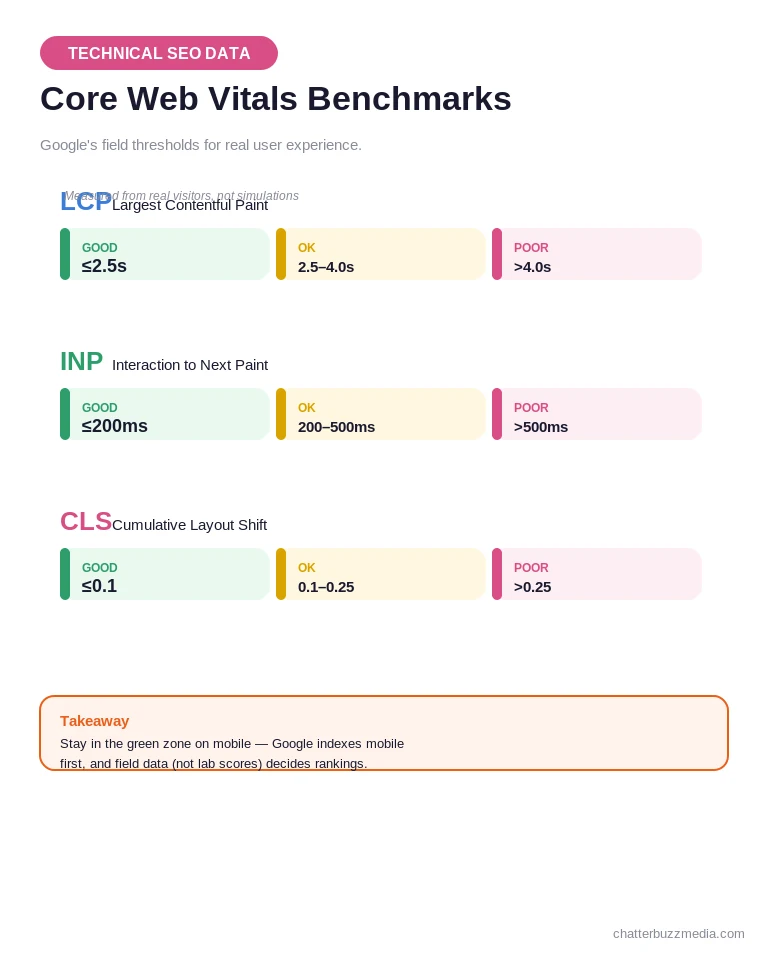
Core Web Vitals measure real user experience across loading, interactivity, and visual stability. Google publishes clear thresholds, and staying inside them protects both rankings and conversions.
The three metrics and their “good” targets are fixed reference points worth memorizing:
- Largest Contentful Paint (LCP): under 2.5 seconds. This measures how fast the main content loads.
- Interaction to Next Paint (INP): under 200 milliseconds. This measures responsiveness to clicks and taps.
- Cumulative Layout Shift (CLS): under 0.1. This measures how much the page jumps as it loads.
Beyond speed, technical health rests on crawlability and indexing. A clean XML sitemap, logical site architecture, and no accidental noindex tags ensure engines can find and store every page you care about.
Mobile performance carries extra weight because Google indexes the mobile version of your site first. A page that’s fast on desktop but sluggish on a phone is a page losing rankings.
The official Core Web Vitals guidance stresses that these metrics reflect field data from real visitors, not lab simulations. That distinction matters because a page can score well in a test and still frustrate users on slow connections.
On-page technical basics still earn their keep, too. Descriptive title tags, a single H1 per page, clean URL structure, and alt text on every image give engines the signals they need to index accurately.
HTTPS, a logical folder structure, and a working internal search all quietly support crawlability. None of them are glamorous, but each removes friction between your content and the engines trying to understand it.
Watch for the silent killers, too. Orphaned pages with no internal links, redirect chains, and broken links waste crawl budget and bleed authority, and they rarely announce themselves until a regular audit surfaces them.
Run these checks on a regular cadence:
- Monitor Core Web Vitals in Google Search Console and PageSpeed Insights for real-world field data.
- Compress images and use lazy loading to cut the biggest source of page weight.
- Fix crawl errors fast so indexing problems don’t quietly sink pages.
- Use a CDN and lightweight themes to shorten load times globally.
Structured data belongs in the technical toolkit as well. Article, FAQ, and organization schema help engines and AI systems understand context, and they can unlock rich results that lift click-through rates.
These fixes often deliver the fastest gains in SEO because they remove ceilings on content that’s already good, a common theme in any audit that surfaces conversion killers.
DO: benchmark speed before and after every change. DO NOT ignore technical debt until rankings visibly drop.
With a fast, crawlable site, the next lever is authority earned from outside your own domain.
Best Practice #5: Earn Authority Through Links and Mentions
Authority in 2026 comes from earned links and brand mentions, not volume tactics. A handful of relevant, credible references outperform hundreds of low-quality links every time.
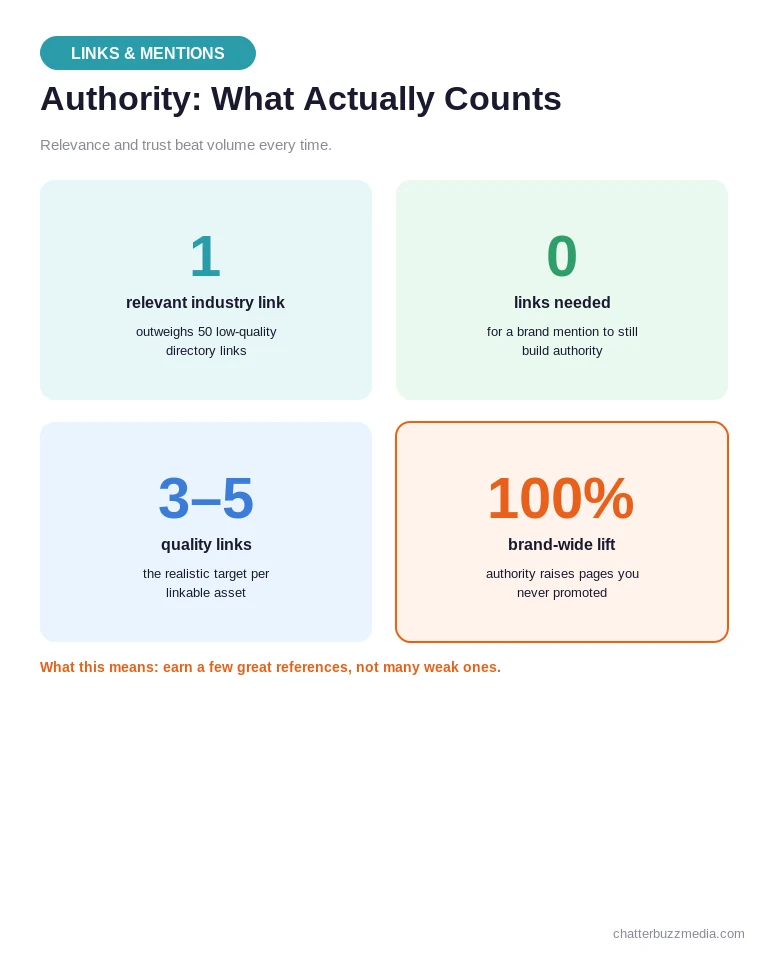
This matters because links and mentions are how the wider web vouches for you. Engines and AI systems read that consensus to decide who deserves visibility on competitive topics.
What’s changed is that unlinked brand mentions now carry weight too. When your name appears alongside trusted authorities, even without a hyperlink, it reinforces the entity recognition that AI answer engines rely on.
Quality is defined by relevance and trust. One link from a respected industry publication moves the needle far more than fifty from unrelated directories.
Your existing relationships are an underused source of authority. Partners, vendors, industry associations, and happy customers can all become natural referrers when you give them something genuinely worth linking to.
Earn authority the durable way:
- Create linkable assets: original research, free tools, and definitive guides attract references naturally.
- Lead with a hook: a fresh data point or angle gives others a reason to cite you.
- Pursue relevant sources: target sites your audience already trusts, not the easiest link.
- Build unlinked mentions: get named in newsletters, forums, and roundups to grow recognition, a core idea in earning links through content.
Digital PR has become the most reliable engine for both links and mentions. A single well-pitched data story can earn coverage across dozens of relevant publications, seeding your brand exactly where authority signals concentrate.
Rule: if you wouldn’t be proud to see a link’s source on your homepage, don’t pursue it. That one filter eliminates most of the low-quality tactics that get sites penalized.
The compounding effect is real. As credible references accumulate, your whole domain rises, lifting pages you haven’t even actively promoted.
DO: invest in assets worth citing and relationships worth having. DO NOT buy links or chase volume, which invites penalties and wasted budget.
Off-site authority is powerful, but for many businesses the highest-intent traffic is local. That’s the next practice.
Best Practice #6: Strengthen Local SEO and E-E-A-T
Local SEO and E-E-A-T signals decide whether high-intent nearby searchers ever find you. For multi-location and service businesses, they’re often the difference between a full pipeline and an empty one.
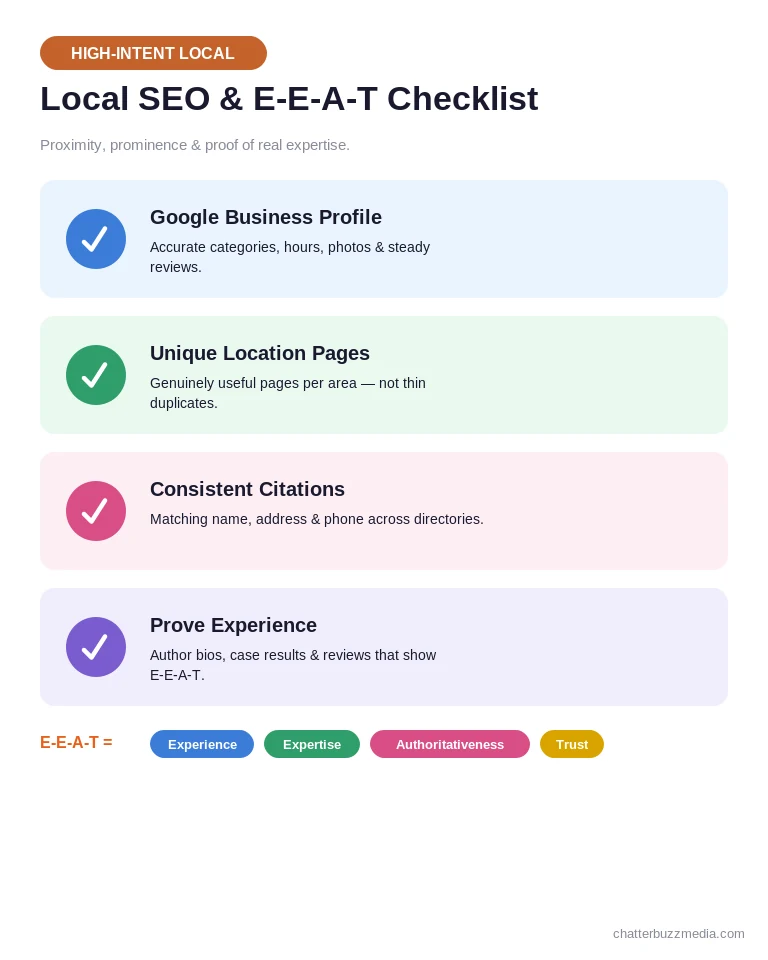
Local search rewards proximity, relevance, and prominence. A complete, active Google Business Profile is the single biggest lever, and keeping it current is not a one-time task.
Local intent now shows up in AI answers too. When someone asks an assistant for the “best option near me,” the businesses with complete profiles, strong reviews, and consistent citations are the ones that get named.
E-E-A-T, which stands for Experience, Expertise, Authoritativeness, and Trust, shapes how engines judge your content quality. It’s especially critical for topics that affect health, finances, or safety, often called “Your Money or Your Life” pages.
The first E, Experience, is the signal most sites underuse. Firsthand accounts, original screenshots, and lessons from real projects are exactly what AI-generated content can’t fake, which makes them your clearest edge.
You demonstrate E-E-A-T through real signals, not claims. Named authors with credentials, cited sources, original data, and firsthand results all tell engines a real expert stands behind the page.
Strengthen both together with these moves:
- Optimize your Google Business Profile: accurate categories, hours, photos, and a steady flow of reviews. See how to optimize your Business Profile.
- Build location pages: unique, genuinely useful pages for each area you serve, not thin duplicates.
- Earn local citations: consistent name, address, and phone details across directories.
- Show real expertise: author bios, case results, and reviews that prove experience, which underpins any multi-location local strategy.
Consistency is what makes local SEO stick. Engines trust businesses whose details match everywhere and whose profiles stay active, which is why treating local as ongoing work beats one-off setup.
Reviews deserve their own attention because they influence rankings and conversions at once. A steady stream of recent, specific reviews signals a thriving business to both Google and the humans deciding whether to call you.
Pro tip: respond to every review, positive or negative, in your brand voice. Engines read active profiles as healthy ones, and prospective customers read your responses as a preview of the experience.
DO: keep profiles, citations, and reviews fresh year-round. DO NOT treat local SEO as a set-it-and-forget-it project.
You now know what to do. Just as important is knowing how to prove it’s working, so let’s talk measurement.
Best Practice #7: Measure the Metrics That Matter
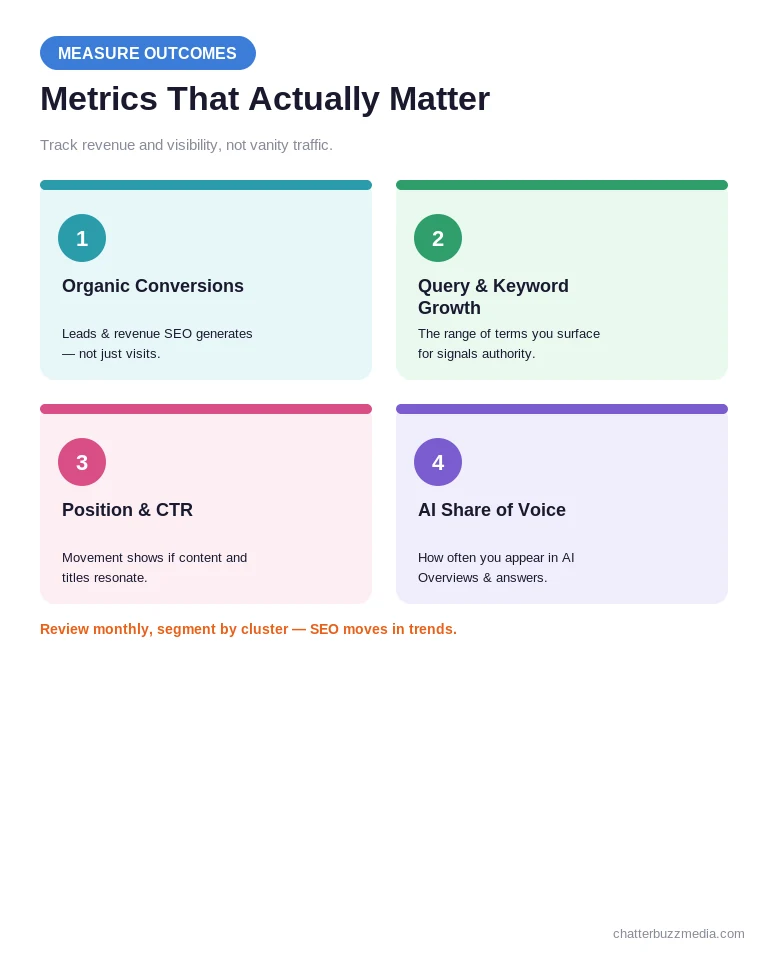
Effective SEO measurement in 2026 tracks outcomes, not vanity metrics. Impressions and raw traffic feel good, but revenue, qualified leads, and visibility across surfaces are what actually justify the investment.
The goal of measurement is to know what’s working so you can do more of it. Without a clear line from SEO activity to business results, budgets get cut and good strategies get abandoned prematurely.
Google Search Console is your single most valuable free tool. Its Performance report shows the exact queries you rank for, your average position, and where clicks are trending, giving you a direct read on whether these practices are landing.
Pair it with analytics that connect sessions to conversions. Rankings only matter if the resulting traffic completes a meaningful action, which is why clear reporting and data visualization turns raw numbers into decisions.
Track this focused set of metrics:
- Organic conversions and pipeline: the leads and revenue SEO actually generates, not just visits.
- Keyword and query growth: the range of terms you surface for, which signals expanding topical authority.
- Average position and click-through rate: movement here shows whether content and titles are resonating.
- AI and share-of-voice visibility: how often your brand appears in AI Overviews and answer engines, the newest frontier to monitor.
Review these on a monthly cadence, not daily. SEO moves in trends, and reacting to normal day-to-day fluctuation leads to changing course before a strategy has had time to work.
Segment your reporting by page and topic cluster, not just site-wide totals. That view shows which subjects are gaining authority and which need attention, turning a vague “traffic is up” into a specific plan for next month.
DO: tie every SEO report back to leads and revenue. DO NOT celebrate traffic spikes that never convert into business.
Measurement tells you what to keep and what to cut. Just as important is knowing which outdated tactics to stop cold, so let’s cover the practices to avoid.
SEO Practices to Avoid in 2026
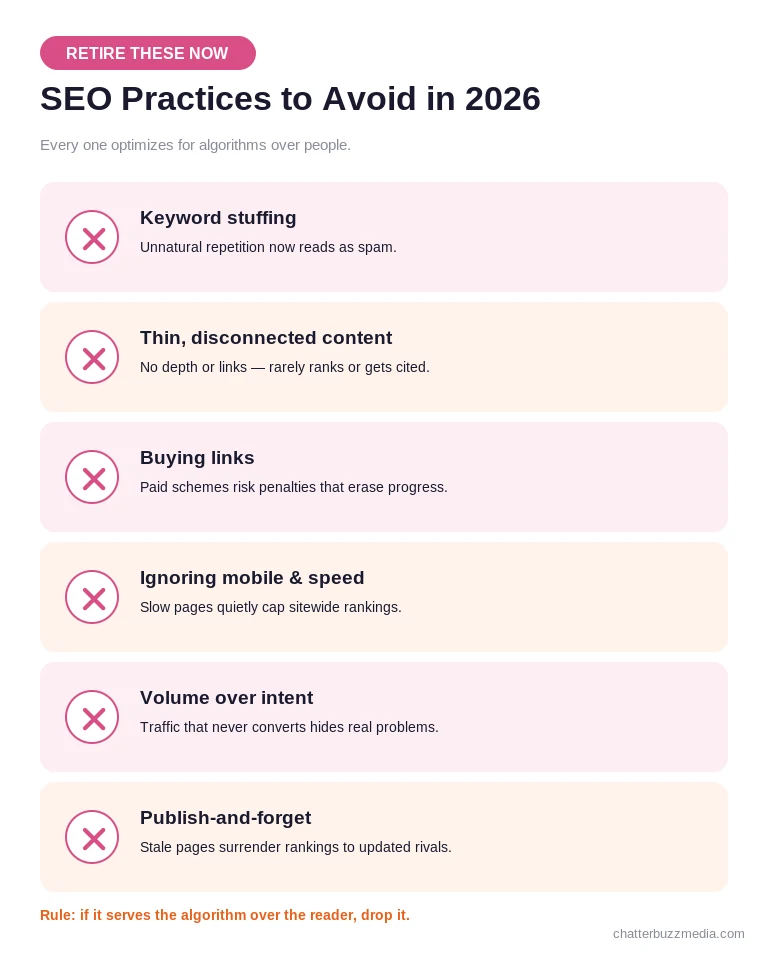
The fastest way to lose rankings in 2026 is to keep using tactics that worked a decade ago. Most stalled sites aren’t missing a secret; they’re carrying outdated habits that actively cap growth.
Recognizing these anti-patterns is as valuable as any best practice. Each one sends the wrong signal to engines that now prioritize genuine usefulness.
Many of these habits persist because they once worked. Tactics from the 2010s delivered short-term wins, and the muscle memory outlived the algorithms that rewarded them.
Retire these practices this year:
- Keyword stuffing: repeating a phrase unnaturally now reads as spam, not relevance.
- Thin, disconnected content: short posts with no depth or internal links rarely rank or get cited.
- Buying links: paid link schemes risk manual penalties that erase years of progress.
- Ignoring mobile and speed: a slow mobile experience quietly caps rankings across the site.
- Chasing volume over intent: traffic that never converts inflates vanity metrics and hides real problems.
- Publish-and-forget content: letting pages go stale surrenders rankings to competitors who update.
Mass-produced AI content without oversight has joined this list fast. Publishing unedited, generic articles at scale floods your site with thin pages that dilute authority and rarely earn citations, the opposite of what the volume was meant to achieve.
Over-optimization is the subtler cousin of keyword stuffing. Exact-match anchor text on every internal link, forced keywords in every heading, and unnatural phrasing all read as manipulation to modern engines.
The pattern behind every mistake is the same: prioritizing algorithms over people. Engines have spent years closing those loopholes, and AI answer layers close them faster.
Audit your existing content against this list before creating anything new. Fixing what’s already dragging you down usually beats adding more, and a structured digital marketing audit makes those drags easy to spot.
Avoid these traps and your fundamentals do their job. Here are the questions people ask most about modern SEO.
Frequently Asked Questions
1. 🔍 Is SEO still relevant in 2026 with AI search?
Yes, SEO is more relevant than ever, but its scope has expanded. The same fundamentals that rank pages in Google, clear intent, strong content, and technical health, are exactly what get you cited in AI Overviews and answer engines.
2. 📊 What is the most important SEO best practice right now?
Matching search intent is the highest-leverage practice. Engines rank the page that best satisfies the goal behind a query, so intent alignment beats keyword density, word count, or any single on-page tactic.
3. ⚡ How long does SEO take to show results?
Most sites see meaningful movement in three to six months, with compounding gains after that. Technical fixes and existing-content updates often move fastest, while new authority and rankings build steadily over time.
4. 🏦 Do keywords still matter for SEO in 2026?
Keywords still matter, but as a guide to intent and topics, not as phrases to repeat. Use them to understand what people want and to structure content, then write naturally for humans and AI extraction.
5. 🤝 What is E-E-A-T and how do I improve it?
E-E-A-T stands for Experience, Expertise, Authoritativeness, and Trust, and it shapes how engines judge content quality. Improve it with named expert authors, cited sources, original data, real results, and a technically trustworthy site.
6. 💰 How do I optimize content to appear in AI Overviews?
Lead each section with a direct, self-contained answer and structure content with clear headings and short paragraphs. Add relevant schema and build off-site brand mentions so AI systems can extract, trust, and cite your passages.
7. 🚀 What are the biggest SEO mistakes to avoid?
The costliest mistakes are keyword stuffing, buying links, publishing thin content, and ignoring mobile speed. Each optimizes for algorithms instead of people, which is exactly what modern search penalizes.
8. 📈 Should I focus on Google or AI search engines?
Focus on both, because the work overlaps almost entirely. Content that’s clear, well-structured, and authoritative performs across Google, AI Overviews, and LLM assistants at the same time, so you rarely have to choose.
Putting Your 2026 SEO Plan Into Action
The through-line of modern SEO is simple: serve people first, structure content for machines second, and the two now reward the same work. Intent, authority, technical health, and clarity are the levers that move both rankings and AI citations.
You don’t need to do everything at once. Start where the leverage is highest and build from there.
Consistency beats intensity in SEO. A steady monthly rhythm of publishing, updating, and technical maintenance outperforms sporadic bursts of effort every single time.
Patience is part of the strategy, not a lack of one. The compounding nature of authority means the work you do this quarter often pays off two quarters from now, so the teams that win are the ones that don’t quit early.
Here’s a four-step action plan to put this guide to work:
- Audit and fix fundamentals first. Check titles, internal links, and Core Web Vitals, and resolve anything failing before creating new content.
- Realign content to intent. Review top pages against what searchers actually want, and reshape mismatches.
- Build one cluster deeply. Pick your most valuable topic and create a pillar with interlinked supporting posts.
- Structure everything for extraction. Lead sections with direct answers and add schema so both Google and AI engines can cite you.
Work through those steps and you’ll be aligned with how search rewards content in 2026, not how it did in 2018. For a deeper walkthrough of building a plan that ties rankings to revenue, explore the complete inbound marketing guide and the full library of marketing resources and guides.

Victoria Wallace
Victoria Wallace is a senior content strategist and marketing writer with 30+ years of experience helping more than 200 brands translate complex business goals into clear, conversion-focused content. Her background spans paid media, marketing strategy, go-to-market planning, brand positioning, and full-funnel campaign development, giving her a deep understanding of how SEO content connects to real business growth.